


Monday, October 31, 2022
Pema Chödrön’s 3 Ways to Transform Your Emotions

BY PEMA CHÖDRÖN|
At the root of our suffering are the destructive emotions that Buddhism calls the kleshas, or poisons. In this exclusive excerpt from her new book, Pema Chödrön teaches us a three-step practice to transform their energy from a cause of suffering into a path to awakening. Illustrations by Carole Hénaff. From the November 2022 issue of Lion’s Roar.

1. Drop into Your Body
“Start with physical sensations because they’re relatively straightforward and provide a good access point to the emotions. Notice how your body is feeling.”
The dharma tells us that all our experiences of discomfort,
anxiety, being disturbed, and being bothered are rooted in our kleshas. This
Sanskrit term means “destructive emotions” or “pain-causing emotions.”
The three main kleshas are craving, aggression,
and ignorance. The first two don’t require much explanation. “Craving” becomes
a destructive emotion when it gets to the point of being an addiction or an
obsession. I was once given some Asian candy whose brand name was “Baby
Want-Want.” That sums up craving quite nicely, I think. We think something will
bring us pleasure or comfort, so we become obsessed with having it or keeping
it. “Aggression” is the opposite: we want to get rid of something that we
perceive as a threat to our well-being.
“Ignorance” as a destructive emotion is a little harder to understand.
It’s a dull, indifferent state of mind that actually contains a deep level of
pain. It can express itself as being out of touch, being mentally lethargic,
not caring what we’re feeling or what others are going through. When this state
of mind dominates us, it can turn into depression.
These three kleshas are often called the “three poisons” because,
as the Tibetan teacher Anam Thubten says, they kill our happiness. This often
happens to us in two ways. First, we suffer while we experience anger,
addiction, depression, jealousy, and the rest; then we continue to suffer as a
result of the harmful actions they provoke.
You probably have firsthand experience of being unhappy when these poisons arise in your life. But how exactly do they kill your happiness? According to the Buddha’s teachings, it’s not the emotions themselves that make us suffer. In their raw form—before we start to struggle with them and before our thinking process gets involved—they are just sensations or forms of energy. They are not intrinsically bad or good. This is important to remember. The destructive aspect of aggression, for instance, is not the sensation; it’s our rejection of that sensation and what we then do as a response. The culprit isn’t the basic energy but the spin-off, what the Buddhist teacher Sharon Salzberg calls “the add-ons.”

When klesha energy
arises, we tend to react in one of a few ways. One is to act out—either
physically or with our words. Another is to suppress the emotion, to go numb
around it; this may involve diverting our attention elsewhere, say by zoning
out with Netflix.
A third common
reaction is to get mentally wrapped up in some kind of storyline, one that
often involves blame. All these reactions are based on our not being able to
bear the discomfort of the energy. We have a propensity to be bothered by this
energy, so we try to escape our discomfort by getting rid of what’s causing it.
This approach is similar to that of the tyrant who kills the messenger bringing
bad news instead of relating to the message. But when we indulge in any of
these reactions, we only strengthen our pain-causing habits and perpetuate our
misery in the long run. Somehow this is a hard lesson to learn.
Everyone has these
habits. There’s no need to blame ourselves or anyone else for this process.
Instead of blaming or feeling helpless, we can apply time-tested methods for
working with our emotions constructively. Like everything else in the universe,
the kleshas and our reactions to them are impermanent and insubstantial. This
is what makes it possible for us to change our habits.
In general, lack of
awareness is what gives our emotions their power. Bringing awareness to them is
the magic key. When we’re aware of what’s happening, they lose their ability to
make us miserable.
The first step in
every method of working with emotions is simply to recognize what’s happening.
One of the characteristics of the kleshas is that they tend to go undetected.
We only notice them when they’ve become full-blown. We’re unaware of the emotion
while it’s just an ember; by the time we smell the burning or feel the fire’s
heat, it’s too late. We’ve struck out in words or actions, or we’re already on
a binge.
Here is a fairly
common example of the life cycle of a klesha. You catch a glimpse of someone in
the hallway, someone you have issues with. You experience a faint tension in
your shoulders or a subtle tug in your chest. This is the ember stage.
Next thing you know,
you’re having judgmental or resentful thoughts about the person. This stage is
like when logs in a wood stove have caught fire. There’s a lot more heat than
at the ember stage, but at least it’s still contained. Even this level may go
unnoticed. But if you keep unconsciously escalating your storyline, it’s as if
you’re pouring kerosene on the fire.
Eventually it will
be too much for the stove to contain and it might even burn down your house. At
that point, you and everyone else will notice, but it will be too late to
prevent a great deal of unavoidable pain. The damaging text message has been
written, you’ve already pressed “Send,” and there’s no way to take it back.
Even then, there are
ways of making the situation better and ways of making it worse. At every
moment, we have these two basic alternatives. We can escalate or deescalate our
misery. We can strengthen unhelpful habits or ventilate them. By becoming more
conscious of what’s happening, we can put out the fire at the ember stage or
the wood-stove stage and save ourselves and others so much grief.
Having a regular meditation practice makes us more aware of what’s happening in our mind, the mental undercurrent that tends to go unnoticed when we’re caught up in our daily activities and interactions. With meditation, we begin to catch some of the ember-like thoughts and subtle emotions that, left undetected, escalate before we notice them.

2. Bring Your Attention to Where You Are
Right Now
“The trick
is to stay present with the energy without acting out or repressing.”
Once we’ve become conscious of the klesha, the next step is to let
ourselves feel it—to feel what we’re feeling. It sounds very simple, but for many
people, this is quite challenging. Some people have difficulty because they’ve
been traumatized. Others have certain emotions that, for whatever reason, they
just don’t want to face. But, like all the other instructions in the dharma,
feeling what you’re feeling is a practice. There are ways to train in
it, to make gradual progress.
First, start with physical sensations because they’re relatively
straightforward and provide a good access point. How do you feel physically?
When we’re out of touch with our body, our kleshas have a greater opportunity
to run rampant. On the other hand, when we’re present and embodied, it’s easier
to be in touch with our mind. So notice how your body is feeling—the aches and
pains and itches, the sensations of heat and cold, the places where you feel
tight or relaxed.
Then look at your state of mind. Is it discursive or settled? What
kind of mood are you in? What emotions do you notice? Here it’s very important
to have an attitude of curiosity and openness rather than judgment. Different
things can come up when we allow ourselves to feel what we feel. We may have
painful memories or intensely unpleasant emotions. That’s to be expected and is
no problem. But don’t push too hard and make this into an endurance trial. The
training should take place, as much as possible, in an atmosphere of
acceptance.
To grow in the ability to know what to do when an emotion grabs
you, it’s helpful to remember three words: embodied, present, and kind. Drop
into your body, bring your attention to where you are right now, and be kind.
When there’s an upsurge of emotion, these three words can help you to
deescalate. The main instruction is to stay conscious and, as Tsoknyi Rinpoche
has said, “You have to be willing to feel some discomfort.”

3. Be Kind to Yourself
“I’ve
discovered that when I’ve allowed myself to feel what I feel, I become more
patient with myself and more forgiving.”
I’ve discovered over time that whenever I’ve allowed myself to feel
what I feel, I become more patient with myself and more forgiving. Each time, I
find myself able to relax with the feeling a little longer. And here’s the
thing: while kleshas cause pain, the klesha energy itself is a limitless source
of creative power, like an electric current. It’s not something you want to get
rid of. The trick is to stay present with that energy without acting out or
repressing. Doing this—or rather, learning to do this—you might find out
something remarkable. In the basic energy of the kleshas, we find
wisdom—ungraspable, egoless wisdom—free of grasping and fixation.
One of the most important ways to work with our emotions is to use
them as a path of awakening. The idea is to allow ourselves to experience the
energy of the kleshas fully and directly. In doing so, we discover that they
contain all the wisdom we need to wake up. An unshakeable confidence comes from
this experience.
We all come into this world with co-emergent unawareness, which is
a basic misunderstanding about how things are. We believe we have some kind of
stable identity, something that makes “me” me—something separate from the rest.
Based on this misunderstanding, we find ourselves constantly getting hooked by
the myriad pleasures and pains the world has to offer. Our mind gets completely
wrapped up in kleshas and all the trouble that goes along with them. The
teachings say that this painful process will continue until we wake up from our
unawareness completely, until we see ourselves and all phenomena as they really
are: fleeting, insubstantial, and wide-open with possibility.
The term “co-emergent ignorance” is interesting because it implies
that ignorance doesn’t appear all alone. The Buddha taught that wherever
there’s confusion, there’s also wisdom: “co-emergent wisdom.” Whenever we get
hooked, whenever our kleshas get triggered, whenever we temporarily lose our
bearings and act out in destructive ways, we are in the grip of confusion. But
that very confusion is inseparable from our deepest wisdom. In the traditional
analogy, confusion and wisdom are like ice and water, which are both made of
the same molecules. The only difference is that ice is frozen and water isn’t.
Confusion is based on having a frozen view of ourselves and the
world. It’s a product of our discomfort with the groundless nature of how
things are. Most of us experience that wide-open space as groundlessness.
Anger, craving, jealousy, and all the other kleshas are part of this
discomfort. If we don’t have effective means of working with them, they can
ruin our state of mind and harm not only us but the people around us. This is
why we learn to work with our emotions.
Using our emotions as a path of awakening is based on simply
letting the emotion be, just as it is. I say “simply,” but letting anything in
our mind simply be is easier said than done. The ego feels at home only when
it’s meddling, trying to fix things. It’s always telling us that we can’t leave
anything alone. So we need patience and courage if we want to learn how to let
our kleshas be.
We first have to give the klesha enough space so we can actually see
what’s happening. We need some perspective on our emotion. This doesn’t exactly
mean distancing ourselves from the klesha; it’s more like positioning our mind
in order to see clearly. Doing so requires us to practice refraining. It
requires a mindful gap before we speak or act. It’s hard to have any
perspective when we’re activated.

Then They Become a Path to Awakening
“When we
allow ourselves to experience the energy of the kleshas fully and directly, we
discover that they contain all the wisdom we need to wake up.”
Having a clear perspective, we let ourselves experience the emotion
as fully as possible. This is similar to letting ourselves feel what we feel,
but it goes further. In this practice, we want to learn what the emotion really
is. Instead of putting it into a category such as positive or negative, we try
to contact its energy directly and intimately, to get to know its very essence.
We want to know it, not merely with our conceptual mind, but deeply, with our
heart and our full being.
Anam Thubten makes the distinction between ordinary kleshas and
conscious kleshas. Ordinary kleshas are what we’re familiar with. For instance,
when we’re in a state of craving, it feels unpleasant, we lack perspective on
it, and we usually react in harmful ways. Conscious kleshas are where the
wisdom lies. When we go beyond our propensity to be bothered by craving, when
we come to experience it as a form of wakeful energy, then the emotion loses
its power to disturb us. Instead it becomes something precious, part of the
preciousness of life.
By relating to our emotions in this way, we discover their
enlightened aspect: the wisdom that is co-emergent with ignorance and
confusion. It is always present, in each and every one of our kleshas. To
contact it, we allow the klesha just to be what it is. Then the ice will melt
and we will experience the open, flowing quality of water.
This isn’t easy. Not only does it take practice to contact the
wisdom in the kleshas, but it also takes practice to distinguish between the
two, between wisdom and nonrecognition. How can we tell whether we’re
experiencing the neurotic aspect of the energy or the wakeful aspect? Often the
clearest evidence is found in our body. Generally, our ordinary kleshas
correspond to some form of physical contraction. We feel a tightness in our
stomach or jaw, or, perhaps more subtly, in our heart or solar plexus. When our
emotions are in the ember stage, this contraction may be hard to detect. But if
we practice tuning in to our emotions and our body, then physical tightness can
serve as an indicator of when we’re caught in ordinary kleshas.
By getting in touch with the physical sensation of our neurosis, we
come to know the feeling of wisdom as well. From this point of view, wisdom
feels like relaxation, expansion, openness. Instead of fighting with our
emotions, we let them be. We don’t act them out or repress them. We simply let
them be. We simply connect with what they feel like. Instead of tightening up
with our strong opinions and storylines, we relax and allow the co-emergent
wisdom in our kleshas to speak for itself. If we practice in this way, our
emotions themselves will become our most direct path of awakening.
Adapted
from How We Live Is How We Die, by Pema Chödrön. © 2022 by the Pema
Chödrön Foundation. Reprinted in arrangement with Shambhala Publications. www.shambhala.com
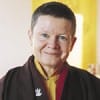
With her powerful teachings, bestselling books, and retreats attended by thousands, Pema Chödrön is today’s most popular American-born teacher of Buddhism. In The Wisdom of No Escape, The Places that Scare You, and other important books, she has helped us discover how difficulty and uncertainty can be opportunities for awakening. She serves as resident teacher at Gampo Abbey Monastery in Nova Scotia and is a student of Dzigar Kongtrul, Sakyong Mipham Rinpoche, and the late Chögyam Trungpa. For more, visit pemachodronfoundation.org.
(Sources: Lion's Roar)
Striking pictures reveal the microscopic world’s hidden wonders

The winners of Nikon’s annual Small World photography contest reveal tiny marvels of the natural world that are normally hidden from sight.
OCTOBER 11, 2022

Throughout history, humans have struggled to understand the realities that exist beyond our natural perception. Whether it’s the vibrant sensory worlds that non-human animals experience, the immensity of the observable universe, or the inner workings of the microscopic realm, there are countless wonders that humans are unable to see directly.
Fortunately, people have mastered the art of magnifying and capturing the minuscule. And every year, Nikon’s Small World Photomicrography Competition celebrates images that bring these diminutive worlds into view. For the competition’s 48th year, four judges sifted through nearly 1,300 submissions and selected a handful of entries that rose to the top.
Announced today, the winner is an image from University of Geneva researchers Grigorii Timin and Michel Milinkovitch that shows the hand of an embryonic Madagascar giant day gecko. Created using microscopy and image stitching, the result is a fluorescent vista that reveals the delicate complexity of the gecko’s hand, highlighting the nerves, tendons, ligaments, bones, and blood cells that work synergistically to help these creatures effortlessly scale walls.
Other images capture a brambly looking cluster of human milk ducts, a puff of smoke, and the fruiting body of a slime mold—an organism that looks as though it were yanked straight from a fantasy story. All of the winners are available for viewing on Nikon’s website, and for this story, National Geographic photo editor Samantha Clark selected 13 images that captured her imagination, demonstrated the power of microscopy, or inspired her to think more deeply about the hidden world that’s just out of sight.
“Seeing eye-to-eye with insects like this is always thrilling. And now every time I look at an asparagus, I might think of this one,” Clark says. “The winning image of the embryonic gecko hand is hypnotizing with all the layers of skin, bones, and blood vessels. And who knew the human colon could be so groovy in this flower-power image of epithelial crypts?”


The Power of Numbers
.png)
.png)

The 2022 United Nations Climate Change Conference (also known as COP27)
is just on the horizon, marking the 27th time a coalition of the world’s
governmental leaders, business decision-makers, and climate activists have come
together to take action in the fight against climate change. And while the
number 27 is naturally front and center with COP attendees, it’s just one of
the relevant climate numbers that should be on business leaders’ minds during
the week’s events. Here are four other key numbers in climate worth
knowing:

1.5 degrees: The goal of limiting global warming to well below 2 degrees, preferably to
1.5 degrees Celsius, isn’t just a suggestion. Also called The Paris
Agreement, it’s a legally binding international treaty on climate change,
adopted at COP21, the first ever COP Cool Effect attended. Help fulfill those
promises made in Paris.
.png)
63%: This is a percentage of how many business leaders think that
their company is leading the way on climate action. Businesses can no longer
sit on the sidelines — governments and individuals need them to step up more
than ever in order to make a real impact.
.png)
$551,000,000,000,000 - This amount, which is more than currently exists
in circulation, is what studies show accepting the status quo and doing nothing
about climate change will cost the world’s economy by 2100. The bottom line is
clear — inaction is something none of us can afford.
.png)
350,000,000 - This is nearly how many carbon credits were issued in 2021
alone, a 220% increase from 2020. Demand is increasing, but the supply of
high-quality carbon projects is limited and prices may rise in the voluntary
carbon market — if you’re considering taking climate action, don't wait.
Even if you won’t be in attendance at COP27,
each of us has a part to play in the fight against rising emissions. The
world’s leaders may be coming together in Egypt soon to help fulfill pledges
they made nearly a decade ago, but businesses and organizations can come
together right now, letting their actions speak just as loudly as any pledge.
Thank you for everything you’ve done, now let’s do a little more — together.
For more inspiration, education and content
leading up to COP27, join us on Medium and our social channels.
The provinces regulating against soil pollution
This week’s big environmental stories 21-28 October
Beijing city recently released regulations to address soil pollution, including by controlling use of pesticides and chemical fertilisers, and strengthening monitoring of industrial polluters.
The new rules will come into force at the beginning of next year. They are one of 15 sets produced by provincial-level governments across China to aid implementation of the national soil pollution law, Jiemian News has reported.
That law, which entered service in 2019, clarified who is responsible for preventing and managing soil pollution, and adopted a protection-first and polluter-pays approach.
Most of the provincial regulations are firmest of all on violations that lead to groundwater contamination, raising the maximum fine to 2 million yuan (US$300,000).
China has been grappling with severe soil pollution for years. In 2014, 16.1% of soil samples collected from around the country showed evidence of pollution, a joint survey by two ministries found.
The issue poses a threat to the quality of arable land and food security. “Heavy metal pollution of soil in southern China, the most important grain-producing area, is more serious than in northern China”, Chen Tongbin, a soil expert at the Chinese Academy of Sciences, told Jiemian.
The primary sources of soil pollution in the last century are non-ferrous metal mining, smelting and discharge of industrial effluent, according to Chen. He warns that once soil pollution occurs, it is difficult and costly to treat.
Su Kejing, director of soil ecology at the Ministry of Ecology and Environment, said earlier this year that the central government will continue to push local governments at all levels to address soil pollution.
(Sources: China Dialogue)
Read More »