August 6, 2021 Chinese State Councilor and Foreign Minister Wang Yi hosted the first meeting of the International Forum on COVID-19 Vaccine...
Read More »
July 9, 2021 The Office of the Commissioner of the Ministry of Foreign Affairs of China in the Hong Kong Special Administrative Region on T...
Read More »
Disappearing Colorado River at a crossroads Let's move beyond the era of dams toward a sustainable future REGISTER Dear Jon, The Colorad...
Read More »
Panellists at a London Climate Action Week event, organised by China Dialogue and E3G, discuss the challenges and opportunities for African ...
Read More »
Purpose of the articles posted in the blog is to share knowledge and occurring events for ecology and biodiversity conservation and protection whereas biology will be human’s security. Remember, these are meant to be conversation starters, not mere broadcasts :) so I kindly request and would vastly prefer that you share your comments and thoughts on the blog-version of this Focus on Arts and Ecology (all its past + present + future).
With an abstention rate of 46% and opposition candidates refusing to recognise the results, Nicolás Maduro’s re-election as President of Venezuela for the 2019-2025 term with two thirds of the vote further intensifies the sense of instability facing the country.
The international community – led by the US, the European Union and Latin American countries forming the Lima Group, which consists of regional opponents such as Brazil and Argentina – is embarking on a new phase of pressure, which in this case would involve sanctions on the hydrocarbon sector.
Within state oil company PDVSA (Petróleos de Venezuela), there is concern that Donald Trump’s government could ban Venezuela’s purchase from the US of the 136,000 barrels of oil-related products that includes diluents that enable Venezuela to process extra heavy crude oil from the Orinoco Belt. It also imports gasoline for vehicles and diesel for thermal power generating plants. Such action would constitute a second phase of restrictions imposed by the Trump administration, given that only last August it restricted any new financing to projects linked to PDVSA.
Possible US sanctions along with the recent notable drop in production levels, carries the risk that the Maduro government may not be able to maintain its commitment to repay its debt to China. The balance of which is estimated to be US$23.6 billion. This should include a 2018 payment of US$5.5 billion on the capital and interest, according to calculations by the consulting firm Ecoanalítica.
Earlier this week, Lu Kang, a spokesman for the Ministry of Foreign Affairs of China, stopped short of congratulating Maduro on his re-election and stressed China’s policy of not interfering in the domestic affairs of other countries. The tabloid paper, the Global Times, the international arm under the auspices of the Communist Party’s the People’s Daily, wrote that Venezuela’s oil reserves – the largest in the world – will guarantee repayment and that cooperation between China and Venezuela goes far beyond oil and money.
International concern
PDVSA’s shipments to the US – its main market – have declined steadily since April 2017. In just one year, the average export to the US has decreased by 33%, dropping to 502,000 barrels per day. This figure is a quarter of total shipments compared to 20 years ago, when the self-declared process of ‘revolution’ began under Hugo Chávez.
The fear in Europe is that the sanctions would also affect its oil and gas companies operating in Venezuela, such as ENI, Repsol, Total, Statoil (now Equinor) and Shell, since they aim to halt financing, investment and trade.
The main investment in hydrocarbons during Maduro’s first six-year term that began in 2013 was the US$1.5 billion Cardón IV natural gas project by ENI and Repsol. Production is around 540 million cubic feet per day. It is slated to enter a new phase of production of 1.2 billion cubic feet.
The search for capital is a challenge for the Venezuelan government, as it tries to become an exporter of natural gas to Caribbean countries and to compensate for the fall in oil production, which has been dropping steadily since mid-2016.
Production problems
In the past year, official figures indicate that oil production has decreased by 31%, reaching a low of 1.5 million barrels per day. This is 20% below the quota assigned to Venezuela within agreements established with members of the Organisation of Petroleum Exporting Countries (OPEC) along with observer nations Russia and Oman.
The Centre for Energy and Environment of the Institute of Advanced Administrative Studies (IESA), the main business school in Venezuela, has warned that the average production drop is 30%, which means it is not managing to produce the number of barrels of oil needed to compensate for the natural decline of deposits, which has historically been around 24%.
Repayment of the debt with China is honoured by shipments of crude oil and fuel to the tune of of 400,000 barrels per day. This amount is not reported as net income to PDVSA, which is in any case expected to be lower this year, despite the fact that the price of oil has increased – in Venezuela’s case to above US$60 per barrel – just over US$15 more than it cost in 2017.
Ecoanalítica’s calculations indicate that the income from oil exports will be US$24.7 billion in 2018, a decrease of US$3.3 billion compared to 2017, and that decrease is due exclusively to the fall in production and to fewer exports.
Studies undertaken by PVDSA’s transnational partners in joint ventures, as well as by the IESA, are unanimous in identifying the reasons that explain the fall in oil production. These include:
A lack of financing. US$20 billion for maintenance, and another similar amount are needed annually for new production, according to IESA’s calculations;
Delays in the purchase or importation of supplies and machinery;
The exodus of qualified personnel in the oil field;
The Venezuelan Prosecutor’s Office arresting PVDSA’s management personnel for alleged cases of corruption, without these charges having been substantiated;
The centralisation of procurement within PVDSA without the delegation of operational flexibility to foreign partners;
Problems of insecurity (theft and robbery) involving both personnel and within the confines of the oil installations.
These problems are threatening Venezuela’s oil revenues – it’s lifeblood. With production crashing and increasing fewer options for generating revenue to repay its main creditors, it seems there is no way of reversing the current, troubling trend.
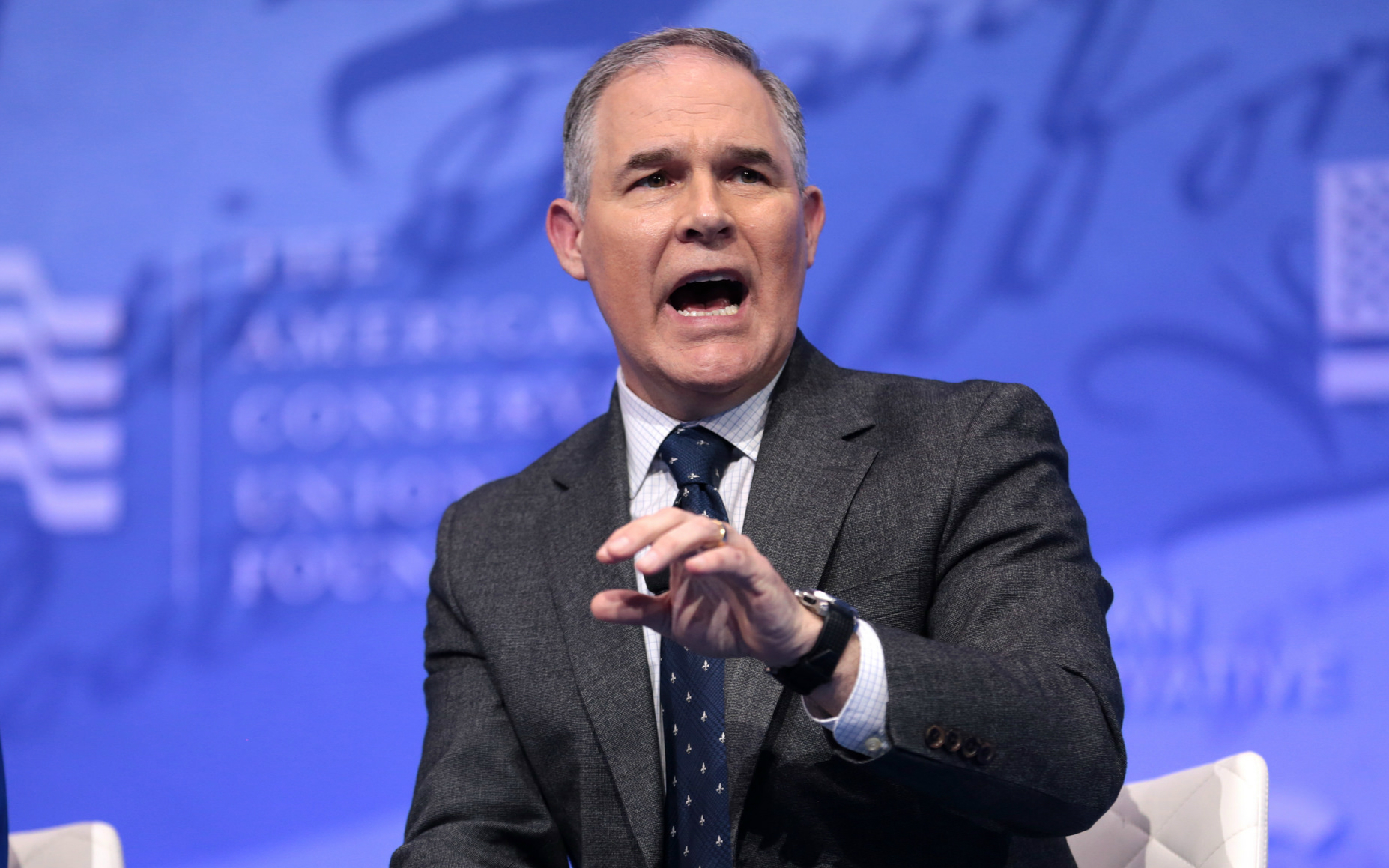
Scott Pruitt is clinging on to his role as EPA Administrator following accusations of inappropriate dealings with lobbyists and unnecessary spending (Image: Gage Skidmore)
The Trump Administration has been marked by scandal after scandal. Controversies involving corruption, potential collusion with the Russian government, and hush-money paid to adult film actresses, have dominated news here in the United States.
Despite these salacious stories, Scott Pruitt, Administrator of the Environmental Protection Agency (EPA), has still managed to make headlines of his own. Now facing 12 separate investigations, it would seem a matter of time before he resigns or hears his boss’ famous catchphrase, “you’re fired”.
But President Trump and other Republican politicians are sticking with the embattled Pruitt. So why is he in trouble, what does it mean for climate change and the environment, and what’s likely to happen next?
While Pruitt has been keen to reduce the amount of money spent on environmental protection, he’s been less careful with his own spending, repeatedly billing the government for first-class travel, significantly increasing the size of his security detail on his first day as Administrator, and building a US$43,000 (274,000 yuan) secret phone booth as part of a concerted effort to avoid scrutiny and oversight of his behaviour.
The reasons for this obsession with secrecy and security have become clearer after a series of freedom of information requests made by journalists and environmental groups.
One of the more serious charges facing Pruitt is that he had inappropriate dealings with lobbyists for fossil fuel companies. These include renting a home owned by the wife of a lobbyist whose clients included major oil and gas companies, at below market rates.
One of the more serious charges facing Pruitt is that he had inappropriate dealings with lobbyists for fossil fuel companies.
Another lobbyist helped organise a trip for Pruitt to Morocco. During the trip Pruitt spent time promoting US liquefied natural gas, a highly unusual topic for the Administrator of the EPA. Months after helping plan the trip the lobbyist, Richard Smotkin, was hired by the government of Morocco as a US$40,000-a-month foreign agent.
Such behaviour by an EPA Administrator is odd, but it’s not unprecedented for Scott Pruitt. When he was a state senator in Oklahoma, he bought a home with yet another registered lobbyist, while also advancing their causes in the state legislature.
He also kept secret a meeting he had with Cardinal George Pell, a noted Australian climate change sceptic. Cardinal Pell is under investigation for sexual abuse of minors. Unsurprisingly, given his choice of dining companions, Pruitt is no great fan of science. He has attempted to limit the use of scientific studies in crafting legislation, while appointing noted climate change sceptics to key positions and ousting more qualified scientific advisors.
More recent scandals even have a Chinese connection. Acting against the guidance of EPA staff, Pruitt exempted Foxconn from federal air quality regulations despite evidence that smog levels in south-eastern Wisconsin, where Foxconn plans to build a new manufacturing facility, were already above federal standards. President Trump attended an announcement of Foxconn’s plans, and Pruitt’s actions are also seen as benefiting Wisconsin’s Republican Governor Scott Walker who is facing a difficult election campaign.
Although Pruitt has been working to advance industry interests, his support has proved a mixed blessing. The Alliance of Automobile Manufacturers, which had lobbied aggressively to cut fuel-economy standards, is now worried that auto manufacturers are facing a “regulatory nightmare” as the EPA and other agencies have gone further than anticipated, creating new legal fights with California and at least 12 other states. The move could result in different standards for different parts of the country, cutting industry profits.
How has Pruitt survived so long? Under any other president, the steady flow of scandal would have ended his service. But Pruitt has made a lot of noise about how he is implementing Trump’s pro-fossil fuel, anti-government agenda, although many of his efforts to slash environmental regulations have subsequently been slowed by more legal challenges.
Under any other president, the steady flow of scandal would have ended his service.
His efforts have endeared him to President Trump and his voter base. Trump has dismissed some of the scandals as the product of an overzealous media and disgruntled environmental groups. A few congressional Republicans have now joined their Democratic colleagues in calling for Pruitt to resign, but for the most part they have stayed quiet.
Another explanation is that Trump has little to gain by firing Pruitt now. His deputy, Andrew Wheeler, is a former coal industry lobbyist, who also worked for Senator Jim Inhofe, another climate change sceptic. Wheeler is seen by insiders as having a similar agenda to Pruitt, but more Washington nous, and fewer scandals. If Pruitt manages to keep his job until the beginning of June, President Trump may be able to keep Wheeler as acting EPA Administrator without Senate confirmation until as late as March 2020.
By contrast, more immediate action would mean a difficult congressional confirmation hearing for Pruitt’s replacement. The recent, high profile resignations of three of Pruitt’s closest aides at the EPA may be a sign of a coming change. Whatever happens next, it’s unlikely to be great news for the environment.
Now more than ever…
chinadialogue is at the heart of the battle for truth on climate change and its challenges at this critical time.
Our readers are valued by us and now, for the first time, we are asking for your support to help maintain the rigorous, honest reporting and analysis on climate change that you value in a 'post-truth' era.
Located on the outskirts of Shenzhen – the Shenzhen East Waste-to-Energy Plant will incinerate 5,000 tonnes of waste per day, generating 550 million kilowatt-hours every year (Image: SHL)
China is looking to solve its immense waste crisis. According to the World Bank, the country is dealing with 200 million tonnes of garbage a year. Landfills are crammed and create a burden for surrounding communities. To deal with the problem, China is building more waste-to-energy plants than the rest of the world combined. But is burning waste the right approach?
Episode 5: Burning waste – China’s solution to ocean plastics
Guests:
Jennifer Turner, Woodrow Wilson Center Doug Woodring, Ocean Recovery Alliance Nickolas J Themelis, Waste-to-Energy Research and Technology Council Christine Loh, HKUST and Civic Exchange Mao Da, Rock Environment and Energy Institute
Welcome to Eight Million – a podcast series that looks at the eight million metric tonnes of plastic entering our oceans every year – and the role China is playing to address this global challenge. Eight Million is produced by Sustainable Asia and its partners chinadialogue and Aya Recording Studio.
[music]
Marcy: Previously on Eight Million
Mao Da: 这种新消费模式使得我…
Voiceover: New consumption patterns like online shopping and food delivery are increasing our demand for plastic.
Mao Da: 是遭遇了空前的危机…
Voiceover: For the moment, we are dealing with an unprecedented crisis.
[music]
Marcy: China is trying to find the solution to solving an immense waste crisis. According to World Bank numbers, the country is currently dealing with 200 million tonnes of garbage a year.
Jennifer: The numbers are hard to get your brain around. […] To give you a nice visual […] you could fill 25 pyramids of Giza with 200 million tonnes of garbage.
Marcy: That’s Jennifer Turner, director of the China Environment Forum at the Woodrow Wilson Center.
Jennifer: And it’s going to get up to about 500 million tonnes in about five years.
Per year. That’s a lot of Giza temples of garbage. And so cities, their landfills are too full, and they need to find a solution. Now it’s intriguing to me, but not surprising at the same time, that China has gone to incineration.
[music]
Marcy: In our last episode we discussed the trouble with recycling. China’s waste import ban has put the world’s waste industry into crisis mode. And like Hong Kong environmental entrepreneur Doug Woodring told me…
Doug: If we really want to solve the problem of waste getting into our waters…
Marcy: We’ll have to look into waste-to-energy.
Doug: 90% of the world’s plastic does not get recycled even though you see a nice recycling triangle on the bottom of every product. That means it is recyclable but it doesn’t get recycled. Most of the world does not have the infrastructure to do that recycling.
Marcy: And what happens with waste that does not get recycled? The Ellen MacArthur Foundation estimates 40% goes into landfills, and a full third ends up leaking into nature. What else can we do with it? I put that question to Nickolas Themelis, a global authority on waste-to-energy technology. I rang him up in his home close to Columbia University, where he teaches. First of all, what is waste-to-energy?
Themelis: Well, after you do all possible recycling and composting on municipal solid waste, you end up with what is called post-recycling waste. With this material, which is at least 50% or more of municipal solid waste, there are two alternatives: you either landfill them, which is the usual way of dealing with them, or you use them as a fuel in a waste-to-energy power plant. It’s a power plant, same as you have for coal and gas, but it uses municipal solid waste instead of coal. […] It is a power plant that makes electricity or heat.
Marcy: So post-recycling waste, can either go to landfill or into a power plant. And China is betting hard on that latter option. Because…
Themelis: To understand we have to look at Beijing, and Beijing has had some 500 landfills around it and inside it. Because what happens with landfills: municipalities and communities build around the landfill…
Marcy: And then the landfill fills up, has to close, and they have to dig a new hole somewhere. Now China sees these pyramid sized waste heaps on the horizon, and decides they’ll need something more efficient than landfills to deal with it all. Enter the Renewable Energy Law, originally drafted in 2005, but since amended.
Jennifer: And each time it has been amended it has had ever greater targets of promoting renewable energy.
Marcy: Jennifer Turner again…
Jennifer: It used to be 10% total electricity from renewable energy by 2010, and when they amended it, it was 15%, and some provinces wanted even more, and so what this law did was it created feed in tariffs and other kinds of incentives for renewable energy.
What is really important in China is that laws are not the only thing that matters, they also had targets in their five-year-plans; so China was suddenly on fire with renewable energy investments.
But also of interest to us […] is what impact this had on waste-to-energy. Without the Renewable Energy Law […] we would not have seen this big boom of waste-to-energy plants in China. Today, there is somewhere between 230-300 waste-to-energy incinerators, and there are targets to build 300 more. The largest waste-to-energy plant in the world is under construction in Shenzhen.
The Shenzhen East Waste-to-Energy Plant is scheduled to go online in 2020. (Illustration: Beauty & the Bit)
Marcy: Safe to say, China is seeing this as a key part of their strategy to combat the waste crisis and stem the steady flow of plastic trash into the ocean.
But the devil is in the details. I discussed this with Christine Loh, you might remember her from episode two, where she taught us the ABC of China’s policy making. As former Undersecretary for the Environment for Hong Kong, she knows a thing or two about waste policy, and let her tell you:
Christine: Waste is really complicated, because there’s so many different types of waste. Each type of waste needs its own plan.
Marcy: And for waste-to-energy,
Christine: What it requires is for people to separate out the organic waste. This is the thing about waste treatment that is complicated: it requires a whole supply and demand chain action.
Marcy: So it gets down to the same lessons we learned on recycling: it’s all in the sorting. And that is one of the areas China is currently lagging behind in. As we discussed previously, as the informal waste picking networks are being modernised, a sustainable infrastructure is still lacking. And this is a problem for the booming waste-to-energy industry.
Jennifer: It is kind of hard for European and American audiences to picture this: you have the world’s fastest growing economy, but you don’t have cities that have really formalised recycling programmes. It is starting in some cities, but they also don’t pull out organic wastes, […] You end up with municipal solid waste that has tonnes of recyclables and lots of organic material, so that makes it very wet. Which for incineration means it’s hard to burn.
Their waste-to-energy would be much more effective if they were actually sorting it.
Marcy: Basically, wet and dry waste require different methods to extract energy in the most efficient way. By not separating the wet and dry, incinerators need to burn at higher temperatures to burn through all the matter. And higher temperatures mean more toxins released.
But Nickolas Themelis, who runs the global Waste to Energy Research and Technology Council, is optimistic about the Chinese plants, and says the surveyed emissions are often negligible compared to alternative solutions.
Themelis: In the US, all the waste-to-energy plants we have shown emit three grams of dioxins, but unintended fires in landfills, which are very good landfills, by the way, […] these fires in landfills emit 1300 grams. 400 times more.
Marcy: And although that is in the United States, there is a global downward trend in the amount of toxins emitted, largely thanks to improving technology and regulation.
Themelis: Before the US waste-to-energy plants knew that they had to capture dioxins, they were putting out 10,000 grams, so it was a big thing, from 10,000 they went down to three. So China, the last survey we made, it was about 23-24 grams of dioxins, and they try to cut that down to five or six.
Marcy: There is some doubt about these numbers though. The Wuhu Ecological Centre in Anhui province, China, has consistently criticised the waste-to-energy industry for not releasing emission data. In 2016, only 77 of the 230 incinerators agreed to disclose data, and a quarter of these plants didn’t meet the emission standards. According to business professionals, the older plants do indeed struggle to meet the standards, but new plants, like the mega plant in Shenzhen, are built with the latest technology and have cut down on emissions significantly.
Another concern often raised by those who oppose this heavy investment in incineration, is that it takes away the incentive to change our ways. The promise of unlimited energy from the waste we generate by the jillions, isn’t really a solution. In 2015, 200 Asian environmental campaign groups signed a document laying out this argument. But, as Mao Da, co-founder of signatory group Zero Waste Alliance, acknowledges:
Mao Da: 在某些条件下也有一定的道理。就比如说…
Voiceover: Under certain conditions, waste-to-energy can be a good solution. For example, small, light, composite packages, meaning there’s a lot of different plastics blended together, those can’t be separated, so the only option is landfill or waste-to-energy. Some plastics are also not suitable for recycling because they can leach toxic chemicals. In these cases, incineration in a well-controlled environment, like as in Japan or in Germany, can be less polluting than recycling.
Marcy: Nickolas Themelis agrees that recycling is better, but says that right now, waste-to-energy is needed to solve the pollution problem.
Themelis: Environmentally, it’s better to have recycling, but there are limitations to what can happen with recycling. And plastics is a good example. Because with all the efforts that have gone to recycling plastics, especially in California, a leader in environmental consciousness in the US; all the efforts that have gone into it, the actual plastics recycling is about 10% of the total plastics generated.
As a matter of fact, anyone who comes to us and who wants to make a waste-to-energy plant – we say make sure you do as much recycling as possible, because there is still room for waste-to-energy plants.
Mao Da: 这并不是我们应该走的路。当我们…
Voiceover: But it is not the way to go. When we’re dealing with plastic products that are impossible to recycle, or when these products can cause harm, they should be eliminated from the market.
Marcy : Reducing the amount of plastics we use is the ideal way to go. And that is what the developed countries are looking into right now. Jennifer Turner compares the approach in Europe.
Jennifer: They have this kind of waste hierarchy. Think of it like a pyramid, with prevention as the base. We are going to try to limit the amount of garbage, so they have got rules and regulations and incentives to limit packaging, getting people to recycle, and trying to create markets using other forms of recovery from landfill like maybe methane recapture from landfill waste. But really they see incineration as the very last final solution to solve their solid waste problems.
But in China they kind of flip that. If we want to view it as a waste pyramid, the top is waste-to-energy, you just throw all this stuff in.
Marcy: With the current waste crisis in China, and the eight million tonnes of plastic entering our ocean every year. That might actually be the way to “stop the source, contain the release”, as Bill Roberson of the USEPA explained to me back in the first episode of this series.
For now at least. And that’s what I keep hearing from the people I got to talk to over the course of this series.
Christine: We’re not even talking about just plastic bottles, which are PET and more valuable, but all kinds of little flimsy plastics and so what do you do with that?! Maybe there’s something you can do with them in the future, but before all that happens, incineration is a real option.
Themelis: China, by building more waste-to-energy plants, I think they will reduce the amount of plastics that end up in the oceans, in the waters, or on land.
Doug: It is absolutely necessary. If we really want to solve the problem of waste getting into our waters.
[music]
Marcy: It is dangerous to draw quick conclusions, and there are no simple answers. If anything, this series has taught me the problem of plastics in our ocean is incredibly complicated. But looking at the way China is tackling this challenge has opened my eyes to the solutions for our global plastic crisis.
I wanna thank everyone who shared their knowledge and experience with me. Here’s a couple quotes to leave you with.
[music]
Nick: In Hong Kong and Peru, many African countries, many parts of Southeast Asia and Asia Pacific, […] In the United States, some shores of the UK, wherever you go, sadly, there’s trash to be picked up, there is plastics on the beach.
Craig: We became so used to seeing it. It became such a part of our lives, that it became invisible. […] As soon as I started looking for it, I saw it everywhere.
Jenna: Eight million tonnes going into our ocean.
Mao Da: 我觉得最直接的是我们很多的塑料垃圾没有得到很好的收集和处理…
Voiceover: The lack of good collection and processing of plastic waste is the reason why plastic from China ends up in the ocean.
Doug: The challenge is that the waste systems today globally are not prepared to handle the myriad of plastics in the waste stream.
Jennifer: It’s intriguing to me, but not surprising at the same time, that China has gone to incineration.
———
OUTRO
This podcast was brought to you by Sustainable Asia.
My name is Marcy Trent Long. Eight Million was co-produced by Sam Bekemans. Audio production by Carsten and Annabat Martens of Aya Recording Studio. Graphic design by Kinsey Long.
A special thanks to Keon Lee, Daniel Suen, and our partners at chinadialogue: Isabel Hilton, Charlotte Middlehurst, Huang Lushan and Christopher Davy.
Share this podcast with your friends and colleagues! Education and collaboration are our best path for creating a Sustainable Asia.
WildAid’s latest shark fin ad campaign in Hong Kong has been fronted by local actor and director Bowie Wu (Image: WildAid)
With a quarter of shark species now facing extinction, the sale and consumption of shark fins has become indefensible to most people following public awareness campaigns and the protection of some species. But in Hong Kong, the hub of the global trade, there is still one familiar refrain: “we only trade in abundant blue shark fins,” merchants and caterers say, “not endangered species.”
Editor’s note
This article is part of an ongoing series exploring the evolving role of Hong Kong as a gateway for unregulated and illegal fishing within the international food trade.
Alex Hofford, a campaigner with pressure group WildAid, calls it the industry’s “get-out clause,” and it’s the official line taken by the city’s seafood traders as well as by Maxim’s, the city’s largest chain of Chinese restaurants.
Maxim’s Caterers, run by managing director Wei Kuo Wu, is a member of the Jardine Matheson Group, a British conglomerate. They are a licensee of global brands such as Starbucks Coffee, Ipuddo Ramen and The Cheesecake factory. In 2016, company profits were US$848 million.
At over 50 outlets citywide, Maxim’s offers what they call “sustainably sourced” shark fin dishes from blue sharks, a species listed as near-threatened by the International Union for Conservation of Nature (IUCN). But a growing number of marine biologists, fisheries experts and green groups are saying that blue sharks have come under unprecedented pressures since 2005 – the year they were last assessed by the IUCN – and will soon join the endangered list if fishermen don’t stop targeting them.
In a letter addressed to Maxim’s, WildAid collected the signatures of over 250 scientists, academics and environmental organisations. As well as celebrities including Sir Richard Branson, Dr Sylvia Earle and Dr Jane Goodall, the signatories are a veritable who’s who of Hong Kong and mainland China’s foremost marine scientists. WildAid’s shark fin campaign has also won the support of Chinese basketball star Yao Ming, and the group’s latest ad campaign in Hong Kong has been fronted by local actor and director Bowie Wu.
Even more exhaustive is the breadth of research catalogued to substantiate their concerns about blue sharks, now the most frequently caught species among the 100 million sharks estimated by a Dalhousie University study to be killed worldwide each year.
WildAid activists demonstrate against the shark fin trade outside a Maxim’s restaurant in Central, Hong Kong (Image: Alex Hofford)
Blue sharks under threat
Recent peer-reviewed research shows that blue shark numbers more than halved in areas of the Pacific and Atlantic oceans between the late 1980s and early 2000s. With year-on-year declines up to 6% globally.
Other species fuelling the shark trade, such as scalloped hammerheads and oceanic whitetips, were brought under CITES Appendix II protection in 2013, thus prohibiting their harvest. Since then, blue sharks have become the dominant species in the shark trade, putting it in peril.
The trouble with their current listing, is that it was last assessed in 2005 using studies published no later than 1999. A lot has changed in the past 19 years.
Changing picture
Globally, there are calls for the reassessment of blue sharks’ status. Last October, Samoa’s proposal to list the blue shark as under threat was accepted by the 12th conference on the Convention on Migratory Species (CMS), held in the Philippines.
Although measures offered by CMS listing are limited to awareness raising and promoting international cooperation, it is considered a springboard to legally-binding protections under the more influential Convention on International Trade in Endangered Species (CITES), which will be hosted next year by Sri Lanka, co-sponsor of Samoa’s blue shark proposal.
Shark fins, dogfish and other sharks, fresh, chilled or frozen: 2 736● Shark fins, dried: 2 658
“Global captures have increased dramatically since 2000,” the Samoan species proposal read, adding that the proportion of blue sharks in total shark and ray landings had more than tripled from 4 to 14% between 1998 and 2011.
According to a 2009 study by Canada’s Bedford Institute of Oceanography, bycatch constitutes a substantial but under-reported threat to highly migratory blue sharks, now the world’s most frequently discarded fish species in pelagic longline fisheries. In the Canadian Atlantic, they estimate that unreported bycatch of blue sharks is about 100 times greater than what is reported.
Blue shark fins remain the most heavily traded of all species in the Hong Kong fin trade
The threats faced by blue sharks are coming from all directions, but despite emerging problems like bycatch and the growing market for shark meat, Hong Kong is still singled out as a particular source of peril for the species.
“Blue shark fins remain the most heavily traded of all species in the Hong Kong fin trade,” according to the Species Survival Network, “comprising 17.3% of fins in 2005 [and] growing to as much as 64% of trade in 2015.”
Setting an example
Campaigners hope that by compelling Maxim’s to take a principled stance before the law forces them to, they can have a “domino effect” throughout the catering industry, similar to when aviation and shipping firms followed the example of Cathay Pacific and Maersk Line to refuse shark fins from their cargo holds.
WildAid’s motto is “when the buying stops, the killing can too,” and they are determined to change consumers’ habits here at the heart of the trade.
In response to chinadialogue ocean, Maxim’s Caterers said that their outlets are seeking to “promote alternatives to shark fin dishes” but have no plans to take these off the menu. Asked whether there was any scientific basis to show that blue shark fins were sustainably sourced, the company’s public relations department did not respond.
Campaigners have started to direct their efforts at US burger chain Shake Shack, whose mission to “Stand For Something Good” has been undermined by their local partnership with Maxim’s. They have demanded to know why Shake Shack’s pledge to work with “like-minded purveyors we admire and love” was not upheld in Greater China, but have yet to receive an answer.
Demonstrators from environmental group WildAid crash the opening of Shake Shack’s first Hong Kong store to protest their local partner Maxim’s involvement in the shark fin trade. (Image: Ryan Kipatrick)
Global market in shark meat
Chinese consumers’ appetite for shark fin soup is far from the only threat to these marine predators. Sea Shepherd’s Asia director Gary Stokes points to the thousands of tonnes of blue shark landed at Japan’s Kesennuma fishing port to be processed into shark cartilage supplement pills, and the havoc wreaked by Spain’s deep water fleet.
Across the European Union (EU), a “fins attached” rule introduced in 2013 has bolstered secondary markets for shark cartilage, organs and meat, Stokes says.
This legislation requires fishing vessels to land the entire shark, rather than slicing off the fin and dropping the carcass back into the sea. Although the policy set out to reduce capture rates, it has also led to a boom in these secondary global markets in shark meat.
“Everyone talks about fins,” Stokes says, “but we need to talk about killing of sharks en masse. It’s not just the Chinese who are eating shark.”
Whether it’s marketed as flake, rock salmon or something else, more and more people in markets such as Spain and Brazil are consuming cheap shark meat, Stokes says. After Sea Shepherd and the East Timor National Police busted a fleet of illegal Chinese fishing vessels last year, Stokes found the holds full of whole sharks due to be processed in China, in a plant that then exports meat to Australia.
While Japan, Taiwan, Indonesia and China continue to play major roles, the largest proportion of frozen shark fins coming into Hong Kong has, until being overtaken by Singapore last year, come from Spanish ships operating off Canada’s coast in the North Atlantic.
Environmental groups are taking on the shark industry from very different angles, but they agree on this fundamental point: that species-specific measures are merely stopgaps and only a complete shutdown of industrial shark fisheries will enable populations to recover.
At a protest in April organised by WildAid outside two of Maxim’s locations, around a hundred shark protection activists rallied to demand that the company follow through on its pledge to “closely monitor new environmental factors, and review [their] strategies responsibly.”
Placards compared diners’ persistent appetite for shark fin to other cultural habits once widespread in Hong Kong but now considered wrong and outdated. These included slavery, footbinding, the use of spittoons, and the buying and selling of young girls known as mui tsai.
Dr Daniel Pauly, an eminent fisheries expert at the University of British Columbia and a signatory to WildAid’s letter to Maxim’s, agrees. “Nothing short of a global ban on finning sharks, and selling, buying and transporting shark fins will do,” he says.
“The rich Romans ate flamingo tongues. Do we trade in sustainable flamingo tongues? No. That’s why we still have flamingos.”